Tuesday, November 26, 2013

Sugar Land offering expanded bulky waste collection after holidays

Residents will have several opportunities to dispose of bulky waste immediately after Thanksgiving, Christmas and New Year's Day - holidays that typically result in oversized garbage.

Bulky waste service is normally provided once per month for items too large to fit in garbage carts. Bulky waste does not include construction, demolition or hazardous wastes.

The additional bulky waste collection schedule will differ from previous years and is posted on the City website. Residents are encouraged to visit the site to determine their collection days for all three holidays.

Guidelines for bulky waste collection follow:

. Set bulky items out by 7 a.m. on the collection day but no earlier than 6 p.m. the prior evening.

. Bulky items should be placed at the curb at least 4 feet from other objects.

. Do not place bulky waste items in garbage carts. They should be placed directly on the curb.

For more information, visit www.sugarlandtx.gov/solidwaste[1]

Source : http://www.yourhoustonnews.com/fort_bend/news/sugar-land-offering-expanded-bulky-waste-collection-after-holidays/article_be37f715-e2ee-5ea5-95bc-dd45845b0ce4.html

What Homebuyers Can Be Thankful for in 2013

miniature house in miniature...


Homebuyers have had it tough lately, suddenly finding themselves in a sellers market as summer came along. And mortgages suddenly cost more too -- when you could even get one. But of course Thanksgiving isn't about looking at negatives. So, if you can, look past that elephant-in-the-room that is the credit crunch and take stock of what's now on the table for those homebuyers with the capital.

Low Mortgage Rates: Yes, mortgage rates rose year, along with home prices, but rates are still at historic lows (we are constantly assured) and have been sinking in recent weeks. Can housing prices be far behind? If you are really ready to buy, those Black Friday bargains are small potatoes compared to what you might save by shopping right now in real estate's historically slow season[2] -- especially from sellers who saw summer's homebuying frenzy pass them by.

A Bidding-War Cease-Fire: The heated bidding wars that have been witnessed in some real estate markets -- especially in California -- reportedly have cooled with weather and amid rumors that sellers were deliberately underpricing their homes[4] to encourage competing bids. And although home prices continued to climb[5] as summer drew to a close, it was at a slower pace. Meanwhile, the number of Americans applying for home loans[6] has plunged.

Weary and Wary Investors: Speaking of the competition, the real estate speculators appear headed for the sidelines after years of swooping in to snatch up bargain properties with ready cash. A recent poll of investors[7] found that only around 1 in 5 are still interested in buying more homes -- about half the number from a year ago. For average home-shoppers that means less competition from a preferred class of homebuyers. Meanwhile, those foreign investors who were reportedly buying Florida property sight-unseen[8] at the beginning of 2013 (and even giving Detroit a nibble) might have moved on to Portugal and Spain[9], where 3 million homes lie vacant and the governments are ready to barter with tax incentives and visas.

The 'Nuclear Option': What does the real estate market have to do with the recent change in the U.S. Senate's filibuster rules[10]? It means that Rep. Mel Watt (D-N.C.), the Obama administration's nominee to head the Federal Housing Finance Agency[11] might finally be confirmed. And if that happens -- and it's only a glimmer of a possibility at this point -- Watt might drop plans to lower the ceiling on the amount of money[12] available for government-backed mortgages. Ideological and political conflicts aside, that would be good news right now for homebuyers who might otherwise not be able to afford their dream homes.

The Latest Technology: In many ways technology has made home shopping easier than ever -- much less dependent on guesswork and reliance on third parties -- and it only seems to be getting more convenient. Along with smartphone apps for homebuyers[13] (many of them free) that calculate mortgage payments and estimate home values, there's at least one that instantly accesses information about a home just by taking a snapshot of it with a smartphone camera. Others detect homes with recent price reductions; screen for upcoming open houses; rate neighborhoods on the basis of crime rates[14]; and do the numbers based on "lifestyle"[15] -- such as how much it might cost to commute to work from a new location. So even if you aren't ready or able to buy, some of these apps can aid in a search for a rental.

Source : http://realestate.aol.com/blog/on/reasons-home-buyers-thankful-2013/

US building permits soar to 5-year high in October

Permits for future U.S. home construction rose to their highest level in nearly 5-1/2 years in October, suggesting the housing market recovery remained intact despite recent signs of slowing down.

The Commerce Department said on Tuesday building permits jumped 6.2 percent to a seasonally adjusted annual rate of 1.03 million units. That was the highest rate since June 2008. Permits increased 5.2 percent in September.

August's permits were revised to a 926,000-unit pace from the previously reported 918,000 units. Permits lead housing starts by at least a month.

The Department postponed the release of housing starts and completions for September and October until Dec. 18 because the collection of data was affected by a 16-day shutdown of the government last month. November data also will be published at that time. The partial shutdown of the federal government also delayed the publishing of the September and October permits reports.

Economists polled by Reuters had expected building permits at a 930,000-unit rate in October.

While permits are not counted in gross domestic product (GDP), they are a key indicator of economic activity and the sturdy gains in both September and October should ease concerns the housing market recovery was stalling.

Higher mortgage rates have slowed the pace of home sales, but demand for accommodation as household formation continues to recover from multi-decade lows is expected to keep residential construction supported.

Home resales fell in October for a second straight month and confidence among single-family home builders has ebbed somewhat since nearing an eight-year high in August.

Permits for the multifamily home sector surged 15.3 percent in October after increasing 20.1 percent in September. Permits for buildings with five units or more reached their highest level since June 2008.

Single-family home permits, the largest segment of the market, increased 0.8 percent after falling 1.9 percent in September.

--By Reuters

Source : http://www.cnbc.com/id/101228329

Monday, November 25, 2013

For Millennials in the Market for a Home Mortgage: 5 Key Questions

couple signing home purchase...


Andrea Murad[1]

Securing a mortgage in a normal housing market can be long and complicated, and the process has become even more arduous in the current environment. With tight lending practices and low inventory levels, potential buyers are facing significant hurdles. What's more, first-time buyers, usually of the millennial generation, have the added pressure of a weak job market and massive student loan debt that limits their purchasing power.

"[Owning a home] is really about deferred gratification," says Michael Corbett, Trulia's real estate expert. "You know where the market's going -- you need money, a job history, and you need to show your debt is low compared to your income." Before Millennials start the home-buying process, experts suggest coming up with a financial plan and meeting with a mortgage professional. While everyone has a different financial situation, a professional can create a strategy for buying that first home.

Saving for a down payment, overcoming a disproportionate amount of debt versus income and understanding a particular market is difficult -- but not impossible, says Andre Brooks, regional sales manager at Wells Fargo Home Mortgage. "There are pockets where people have become successful; it's a matter of being educated and informed about your market and the finances to buy a home."

It's no secret that homeownership requires major financial planning and comes with sacrifices. Experts suggest Millennials ask the following questions to determine if buying a home is the right decision and how to make the process as smooth as possible:

Is this the right time to buy a home? The cost of owning a home is a lot more than just the monthly mortgage payments. Buyers need to be prepared to cover costs like maintenance, decor and insurance.

"Just because you can get a loan does not mean it's the best thing," says Karen Goodfriend, certified public accountant and principal at KK Wealth Advisors. Buying a home can be very emotional, but sometimes it's best to wait until things are better positioned in life.
"What's really important to you and what things are you really willing to do to save?" she asks.

Where do you want to buy? "The key is, if I know and understand the real estate market I'm buying in, if I know the options to accumulate money, then I can figure out a game plan," says Brooks. "This game plan may extend over six, 12 or 36 months."

The amount of time that a buyer plans to spend in the new home is important when it comes to recovering closing and moving costs -- which can take up to seven years. For a buyer not planning to stay that long, Brooks suggests buying in a marketplace that's experiencing a sustained price increase to have the best chance of breaking even.

What can you afford? Lenders need to see sellers can afford the mortgage -- long gone are the days of unverified loans. "Speak to a mortgage professional to find out what it will take to qualify for a loan," says Goodfriend. Before looking for a home, experts suggest getting prequalified to set price limits. Along with income, lenders also take into account a borrower's debt-to-income ratio, known as a DTI, and any credit card and student loan debt can raise this ratio. "Your DTI will tell you what kind of house you can afford -- a massive student loan will eat into your income," says Corbett.

While quickly eliminating student debt is a big hill to climb, Frank Donnelly, chairman of the board of the Mortgage Bankers Association of Metropolitan Washington, advises consolidating these loans to lower your monthly payments and DTI ratio. "It all starts with a budget and having good discipline," says Goodfriend. "Living within one's means and not having credit card balances will help someone afford a loan and get a loan." Paying off student loans will really help you qualify for a mortgage but this requires a plan to pay off debts and layering in everything else that will help you get a mortgage.

Do you have good credit? Before applying for a mortgage, experts suggest consumers review their credit history and address any issues. "Know what you need to do to build credit if you don't have a lot of it," says Cara Ameer, broker associate and Realtor at Coldwell Banker Vanguard Realty based in Ponte Vedra Beach, Fla. Good credit not only helps get qualified for a mortgage but it also helps keep the interest rate on the mortgage low.

"Think about your credit score as an asset," says Goodfriend. "You want to be in the best position possible to get a mortgage." Paying credit cards late or carrying a high balance can make getting a mortgage difficult. "Be disciplined about spending and paying credit cards on time," she adds.
Some young buyers who haven't established a strong credit history might need some help. "Without good or enough credit, you may need a cosigner on the loan," says Ameer.

Have you saved enough for a down payment? "If buying a home is a goal, it may take years to be able to save for a down payment but have a strategy and work towards it," says Goodfriend. Although everyone's income will likely increase over time, experts suggest putting 20% down on a new home. "Just because the bank will loan it to you doesn't mean you should take the loan," says Corbett. "If you aim for the 20% down, the worst you can have is money in the bank."

Many first-time buyers make some kind of sacrifice to save this amount, says Donnelly. Cutting back on discretionary spending, such as dinners out and entertainment, will help lower expenses, and getting another job can increase your income.

"Research the different loan programs that are geared towards a first-time buyer," says Ameer. Some assistance programs can help with the down payment and closing costs but these loans might be more expensive.

Source : http://realestate.aol.com/blog/2013/11/25/millennials-shopping-home-mortgage-questions/

Pending home sales fall again- National News


Signed contracts to buy existing homes fell for the fifth straight month in October, as the government shutdown added to an overall slowdown in the U.S. housing market. So-called pending home sales eased 0.6 percent from an upwardly revised September reading and are down 1.6 percent from October 2012, according to the National Association of Realtors.

This is the lowest sales pace since December 2012. Pending home sales are an indicator of closed sales in November and December.

(Read more: Do homeowners need underwater insurance?)
[1]

"The government shutdown in the first half of last month sidelined some potential buyers. In a survey, 17 percent of Realtors reported delays in October, mostly from waiting for IRS income verification for mortgage approval," said Lawrence Yun, chief economist for the Realtors in a release.

Existing home sales drop to 3.2 percent

CNBC's Diana Olick reports on the disappointing numbers and how the low rate of first-time buyers is hurting the market.

Regionally, gains in pending home sales in the Northeast and Midwest were stronger, while the South and West saw deeper declines. Sales rose 2.8 percent month-to-month in the Northeast and 1.2 percent in the Midwest. Sales slipped 0.8 percent in the South from September and in the West the decline was steepest, with 4.1 percent fewer buyers signing contracts.

(Read more: Worrisome housing signs appear in West)
[2]

"We could rebound a bit from this level, but still face the headwinds of limited inventory and falling affordability conditions. Job creation and a slight dialing down from current stringent mortgage underwriting standards going into 2014 can help offset the headwind factors," Yun said.

While the Realtors' survey, which draws its data from regional multiple listing services, showed a big drop in the usually investor-heavy West, another report saw investors returning to the market in October after stepping back earlier in the year. After surging to 23 percent of the market in February, investors made up just 16.6 percent of home buyers in August, according to Campbell/Inside Mortgage Finance. Over the past two months, however, that share has climbed back to 17.4 percent.

(Read more: Map: Tracking the recovery)
[3]

"The two-month rise in investor activity is significant given that it occurred at the same time the proportion of distressed properties in the housing market has continued to fall," the report said.

By CNBC's Diana Olick. Follow her on Twitter @Diana_Olick[4].

Questions?Comments? facebook.com/DianaOlickCNBC[5]

For the fifth straight month in October existing home sales fell, as the government shutdown added to an overall slowdown in the U.S. housing market.

Source : http://www.cnbc.com/id/101225161

Judge Jeff McMeans announces re-election bid

Fort Bend County Court at Law #2 Judge Jeff McMeans has announced he will seek re-election as the Republican nominee in the March 4, 2014 primary and the November 4, 2014 general election.

McMeans was elected in 2010 and seeks his 2nd term in office. His father, Walter McMeans, held the same office for 24 years before retiring. "My hope is to be as respected and as dedicated as my father was in his tenure as Judge," he said in a statement.

After earning his law degree in 1992, McMeans practiced in the areas of criminal, family, juvenile, civil and probate law. He was a respected trial lawyer and mediator who ran his successful law firm in Richmond until his election to the bench.

A lifelong resident of Fort Bend County, McMeans grew up in Sugar Land and graduated from Dulles High School in 1984. He earned a BA degree in Political Science from Texas A&M in 1988, and received his Doctor of Jurisprudence from Texas Tech School of Law in 1992.

"It is an honor to serve the citizens of Fort Bend County and make a difference in many juvenile lives in the county where I grew up," McMeans said. "I will continue to be fair, honest and tough as Judge, and want to set an example for my two sons who are also growing up here in Fort Bend County."

Source : http://www.yourhoustonnews.com/sugar_land/news/judge-jeff-mcmeans-announces-re-election-bid/article_598d60ca-42ef-599c-aac0-77f7e683ed6f.html

Thursday, November 21, 2013

Mortgage rates fall amid weak economic data

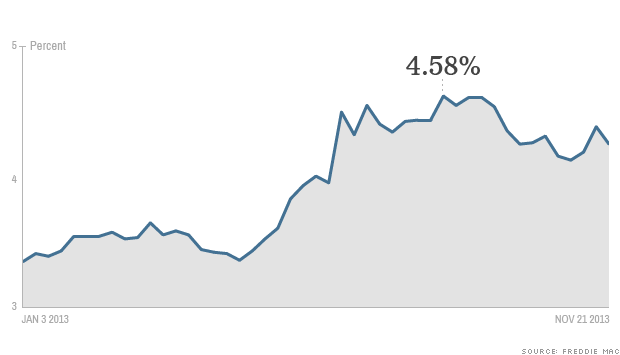
Average rates on 30-year fixed mortgages fell to 4.22% this week, down from a 2013 high of 4.58% in August.  NEW YORK (CNNMoney)

Mortgage rates fell significantly this week amid weaker-than-expected economic reports, according to a weekly survey by Freddie Mac.

30 year mortgage ratesThe average rate for a 30-year, fixed-rate loan, the most popular mortgage product, fell to 4.22% from 4.35% last week, Freddie Mac reported. Meanwhile, average rates on 15-year, fixed-rate loans, typically used for refinancing higher interest mortgages, dropped to 3.27% from 3.35% the week before.
This week's drop was one of the steepest during a year of mostly rising rates. The 30-year started 2013 at 3.34% and reached a high of 4.58% in August.
Related: American Dream homes: What you'll pay in 10 cities[1]
Frank Nothaft, Freddie's chief economist said fixed mortgage rates fell amid reports of weaker manufacturing growth, with industrial production declining by 0.1% in October, below expectations. He also cited declines in the overall inflation rate, noting that the consumer price index saw its "smallest increase since October 2009" last month.
Is there a housing bubble in California?  [2]
Is there a housing bubble in California?
Weighing on mortgage rates long-term is the Fed's stimulus program -- known as quantitative easing -- which entails that it buy $85 billion in bonds each month. The impending appointment of Janet Yellen as Fed chairman[3], who has defended the QE3 policy, has many believing the Fed's policy will remain in place.
Related: Five of the most (and least) affordable housing markets[4]
"Ms. Yellen would likely continue the QE policies started under Chairman Bernanke until there was very clear evidence that the economy would thrive, not just endure, without them," said Keith Gumbinger, a spokesman for HSH.com, a mortgage information company.
Find Homes for Sale…Check Out www.pearlandhomesforsale.biz.  Your Home Resource for Pearland and surrounding areas


Source : http://rss.cnn.com/~r/rss/money_realestate/~3/BsqpbQr8B0w/index.html 

Houston Methodist Sugar Land Hospital uses advanced 3D CT

Bryan Godoy is a fit and healthy 17-year-old who is extremely active and passionate about sports. He had just graduated high school and was looking forward to starting college when he was accidentally kicked in the face during a soccer game. The bones supporting his left eye and left face were shattered and deformed, pushed inwards by about an inch and pushing his eye and jaw out of place.

"This was one of the worst fractures I have ever seen, even considering cases I have treated following car accidents and in patients who had been bucked in the face by a horse," said Dr. Jon Mathy, a board certified plastic surgeon with additional subspecialty fellowship training in microvascular surgery and head & neck surgery at Houston Methodist Sugar Land Hospital.

Because of specialists providing expert facial reconstruction surgery that uses cutting-edge 3D CT scan technology, Bryan's bone fragments were systematically returned to their anatomic positions.

"We are pleased to provide these services to those patients in the Fort Bend community who suffer traumatic facial injuries," Mathy said. "In the past, patients in our area would have to travel to the medical center for complex facial reconstructive surgery. Now they can receive the same level of expert care close to home."

3D CT scan technology provides Mathy with high-resolution, 3D renderings of a patient's facial anatomy that he can use to plan individualized treatments to optimize their facial function and aesthetics.

After Bryan's operation, the Imaging Department at Houston Methodist Sugar Land Hospital performed a fine-cut, high-resolution CT scan of Bryan's craniofacial bones. These were stitched together into a 3D rendering that allowed Dr. Mathy to assess the outcome of the operation, including hardware positioning and facial symmetry.

"3D CT scan technology is extremely helpful from a reconstructive and cosmetic standpoint," says Dr. Mathy. "It allowed me to evaluate Bryan's facial bones in three dimensions to ensure that we had restored the functional elements of his face important for vision and eating. It also allowed me to optimize facial symmetry and aesthetic appearance. For Bryan, we were able to restore his appearance and correct the traumatic disfigurement that he had." Bryan is extremely pleased with the results.

"I am so thankful for the level of expert care I received from Dr. Mathy and Houston Methodist Sugar Land Hospital," says Bryan. "I can look in the mirror and feel good about myself again."

For more information about Houston Methodist Sugar Land Hospital, visit houstonmethodist.org/sugarland[1] or call 281.274.7500 for a physician referral.


houstonmethodist.org/sugarland (houstonmethodist.org)

How a Real Estate Agent Who Knows VA Loans Can Save Vet Thousands


Shutterstock

Selecting a real estate agent is one of the most important choices you'll make when buying or selling a home. The decision becomes even more important when you're a veteran or active duty service member looking to use the VA mortgage guaranty. This nearly 70-year-old loan program backed a record 630,000 home loans in fiscal year 2013, nearly double the 2011 volume.

That's a huge increase in just two years' time. You typically only need a credit score[1] of 620 to qualify for a VA loan, which is more than 100 points lower than some other mortgage products. (It's important to check your credit before applying for any home loan, including VA loans. You can pay for a credit score or use a tool like the Credit Report Card[2], which gives you free credit scores and a breakdown of what's impacting your credit.)

As lending standards have become more stringent, greater numbers of veterans are using their VA loan eligibility as the only realistic path to homeownership. The VA loan is a specialized loan program only available to those who have served our country, and, because of this, it comes with some unique requirements. Veterans can really benefit from an agent[3] who can educate and guide them through the entire process.

Closing Costs: If you've done much research on purchasing a home or have purchased a home before, you know there are closing costs associated with the loan. "Closing costs"[4] is an umbrella term for the fees and costs charged by the lender and third parties who conduct work on your file throughout the process, such as a title company. They research the chain of title for the property and complete a significant amount of paperwork to assist in your home purchase. Working with a VA-knowledgeable agent can even save you thousands of dollars when it comes time to go under contract.

The VA has established a list of certain fees[5] that you, as the buyer, are not permitted to pay. This is good for you, because it means your overall cost is lower. But your agent needs to understand these non-allowable costs so they can try to ensure the seller covers them when drafting an offer. Agents should also know how to structure an offer and eventually a contract to deal with closing costs. Because the VA loan is 100 percent financing, meaning you don't have to put any money down, you're not generally able to roll your closing costs into the purchase amount. But that doesn't necessarily mean you're stuck paying them, since your agent can ask that the seller pay all closing costs.

Your second option is to decide how much you want to offer on the home, get an estimate of your closing costs and then add the two together. By making an offer combining the two amounts, you are effectively rolling the costs into the loan. Sellers are generally more accepting of this method because it doesn't change their bottom line.

It's important to note here that the home will have to appraise for the full contract amount. If it doesn't, you'll have to renegotiate to lower the price or walk away from the deal. Agents unfamiliar with this strategy could mean thousands of dollars paid out of pocket to cover these costs or completely restructuring the contract, adding additional time to the process.

Property Requirements: The VA also has a set of minimum property requirements (MPRs) to ensure the property is safe and structurally sound for a veteran homebuyer and their family. A few examples of common MPRs include peeling lead-based paint, exposed wires or lack of a handrail on stairs. These repairs generally have to occur before you can close on the home, and, if the seller refuses or the repair can't be done, you will likely have to walk away from the home.

Failing to satisfy the property requirements can absolutely kill your deal. Veterans can also run into trouble trying to purchase unique properties, like geodesic domes, berm homes, A-frames and other relatively uncommon structures. The home appraisal process[6] revolves around good recent comparable home sales, and it can be tough to find workable "comps" for unusual homes or properties with significant acreage. Appraisals can cost around $500, which is a lot to spend on a home that's never going to fly with the VA appraisal process. That's why agents who understand these requirements can save veterans time, money and heartache.

VA-savvy agents can steer you from problematic properties at the outset, and also help guide you to closing if there's a shot at making the deal work. The experience of a VA-knowledgeable real estate agent is invaluable when shopping for a home. Be sure to ask any agent you interview whether they've closed VA loans before, and, if so, how many. By working with an agent experienced in VA loans, you'll be on the right track to a smooth home purchase.

Source : http://realestate.aol.com/blog/2013/11/21/real-estate-agents-va-loans/

Clements HS students benefit from $15.7 million Fort Bend Education Foundation grant

Computer Science students at Clements High School are exploring the field of engineering by taking part in a pilot program made possible through a $15.7 million Fort Bend Education Foundation grant funded generously by Schlumberger.

The pilot program will provide educational programs to assist students in STEM (science, technology, engineering and math) labs. Included in the agreement are 25 Licenses for Petrel Software, which supports the study of petroleum, earth science and technology, as well as 25 Licenses for Ocean Kit Software that are geared toward science, technology and engineering. Schlumberger will also provide a new computer lab equipped with 25 computers.

Participating in the program this year are Clements students enrolled in Computer Science III classes, led by teacher Lubna Lorena. The students will benefit from working with a college-level intern and engineers throughout the school year.

"We are extremely grateful to Schlumberger for their support of our Computer Science program," said Lorena. "I am delighted at the thought of the opportunities that our students will have the doors which will be opened for them and the learning that will take place. For me personally, this program represents the realization of a dream. I have the means to enhance my instruction and the resources that will allow the Computer Science program to strengthen and grow."

Schlumberger employees understand the importance of sharing their products and expertise to expose students to computer science and engineering. "It is definitely our goal to introduce concepts and partnerships that will encourage students to excel in science, technology, engineering and math (STEM) and continue on to STEM majors and careers," said Paula Harris, Schlumberger's director of community affairs.

Schlumberger currently collaborates with more than 530 universities worldwide in providing this program. Clements is one of only two high schools in the world to pilot the program.

"I would like to thank our business partner, Schlumberger, for their outstanding and continued support for the teachers, students and schools in Fort Bend ISD," said Brenna Smelley, executive director of the Fort Bend Education Foundation.

Source : http://www.yourhoustonnews.com/sugar_land/news/clements-hs-students-benefit-from-million-fort-bend-education-foundation/article_fc807e12-33ad-57f6-84e4-c9b3135dc7e0.html

Wednesday, November 20, 2013

Fort Bend “Drug Take Back” event yields nearly 600 pounds of unwanted medication

More than 150 community members took part in the Drug Enforcement Administration's "National Drug Take Back Initiative," sponsored by the Fort Bend Police Department, Safe and Drug-Free Schools Department and the Fort Bend Community Prevention Coalition. The event gave community members the opportunity to clean out their medicine cabinets of old, expired or unwanted medicine and avoid giving youth access to the medications, which can lead to abuse and addiction.

Among those taking part in the event were Marie Hoyte and her son, Shawn Thibodeaux. Shawn is a heart transplant patient. He and his mother learned about the Drug Take Back event from their CVS pharmacist.

"My son and I are both heart patients, and my husband is a spine patient," said Hoyte. "Between the three of us, we have several bottles of medication that we can no longer use. We asked our CVS pharmacist where we can dispose of the medication, and he suggested we drop them off at this event."

The event also welcomed community members who disposed of medications belonging to family members who recently passed away, led group collections throughout their neighborhoods, and simply cleared out their personal medicine cabinets. Combined, community members dropped off more than 580 pounds of medication for safe disposal.

Source : http://www.yourhoustonnews.com/sugar_land/news/fort-bend-drug-take-back-event-yields-nearly-pounds-of/article_18439db2-6db8-55bb-b75c-89a9ecc96e2e.html

Sugar Land's tax rate ranked lowest among Texas cities

Sugar Land again has one of the lowest tax rates in the state, according to a Texas Municipal League survey of 657 Texas cities.  

When comparing cities with populations greater than 25,000, Sugar Land's tax rate of 30.895 cents was the lowest. The report also included the following results for 31 cities with populations of 60,000 to 400,000: 

2013 TML Tax and Debt Survey


Group Average


Sugar Land

Sugar Land

Rank

Tax Rate

57.599 cents

30.895 cents

Lowest

Taxable Value per Capita

$ 61,667

$ 114,783

2nd Highest

Population

131,154

84,511

24th Largest

Net Taxable Value

$7.8 Billion

$9.7 Billion

8th Highest

Tax Backed Debt as a Percent of Taxable Value

2.54 percent

2.4 percent

15th Lowest

These results of the survey are another example of the City's strong economic health, contributing to the public's continued confidence in the City's responsible financial stewardship.  The City's sound fiscal management has resulted in a AAA bond rating from Standard & Poor's and Fitch, allowing Sugar Land to finance capital improvement projects at competitive rates.

Source : http://www.yourhoustonnews.com/sugar_land/news/sugar-land-s-tax-rate-ranked-lowest-among-texas-cities/article_2a6b2b6e-522b-11e3-8b7f-0019bb2963f4.html

School finance lawsuit reopened; still on way to Supreme Court

When District Judge John Dietz ruled Texas' school finance system unconstitutional earlier this year, everyone expected the state to appeal.

And appeal it did. But along the way, the Legislature restored some of the money cut during the previous session, and made other changes to the state's education accountability system, leading Dietz to reopen the record and allow supplemental evidence about the new education bills.

"The Supreme Court needs to see that the new developments have been considered," said David Thompson of Thompson and Horton, and lead attorney representing one of the plaintiff groups. "I think it's the right thing to do."

Thompson gave an update to Spring Branch ISD trustees Monday, Nov. 11. Spring Branch is one of 84 districts in Thompson's Fort Bend ISD group that sued the state, claiming the school finance system is inadequate, inequitable, unfairly allocates funding to local districts and relies too heavily on property taxes in local districts.

The Fort Bend ISD group represents some 1.8 million schoolchildren, including Houston and Katy ISDs and most large suburban districts in the Houston area. The four groups bringing suits collectively represent some 630 school districts and 3.6 million schoolchildren, "the largest group of students ever" to join in a school finance lawsuit, Thompson said.

Dietz ruled in February that the state's school finance system was not equitable, not adequate, not suitable and creates a state property tax.

"It was probably the most sweeping decision in favor of schools in (Texas school finance) history," Thompson said.

Thompson said that while the 83rd Legislature this year restored $3.7 billion of the $5.4 billion cut by lawmakers in 2011, it didn't put it back in the same places where it was cut.

He said that the two sessions can't be looked at as disconnected but as "two halves of a whole."

"The combined effect of the two years was to level the system down, at the same time the state is raising its standards" said Thompson.

"Did the money put back this session help? Yes." Thompson said. "Is this a fundamental change of the system? No. It's a tweaking around the edges."

Public education in Texas is enshrined in the state constitution, in language that has remained unchanged since 1876. That language states that an educated populace is essential to a free society, and mandates the state "to establish and make suitable provision for the support and maintenance of an efficient system of public free schools."

Thompson said that "efficient" has been interpreted in earlier lawsuits to mean "equitable" and that equity doesn't have to be perfect but "roughly" equitable.

"Historically, (standards) have been pulled down, rather than up, and the courts have said 'no, equalize up to standards," he said.

He said that he didn't think the bills passed this year would change the case's outcome, and that the system is still unconstitutional. His goal is to get school finance "front and center" for the 84th Legislature in 2015.

Spring Branch ISD Superintendent Duncan Klussmann will give testimony through deposition as the case is reopened, representing the districts that are considered property wealthy but have significant populations of underpriveleged students.

Spring Branch ISD is a chapter 41 district, subject to the so-called 'Robin Hood' plan of school wealth equilization. And besides sending money to the state each year, as the district's cumulative appraised value rises, it gets less funding from the state as it collects more revenue locally. The district has advocated legislators for several years about returning control of local dollars back to districts.

Source : http://www.yourhoustonnews.com/sugar_land/news/school-finance-lawsuit-reopened-still-on-way-to-supreme-court/article_a425111e-520c-11e3-afab-0019bb2963f4.html

Because No One Plans to Be Homeless

Hi, Book Scan readers. I spent the first part of last week hanging out with community planners at the American Planning Association's national conference. Though I haven't read the book described below, I thought the author (who gave the closing keynote at the conference) had some beautiful thoughts on home ownership that real estate professionals would appreciate. Enjoy! —MW

Early Pearl has a great idea for dealing with an intractable problem. As a homeless 11-year old Chicagoan, she sees all of the sturdy housing stock that stands empty and abandoned in her south side neighborhood and decides to take action.

From the cover of Blue Balliett's new book, Hold Fast

She gets some friends together and, with a few cameras, they snap pictures of these empty houses. They send the pictures—along with their imaginings of how the structures could be transformed into dream homes for kids without anywhere to live—to community leaders in an effort to spark a change in their unfortunate circumstances.

Early is only a character in Blue Balliett's newest mystery novel, Hold Fast[1] (Scholastic Press, 2013). But there are more than 30,000 kids in Chicago alone who are homeless just like she is, and some 16,000 vacant properties like the ones that Early dreams of inhabiting.

"Kids will easily share their dreams about a home," Balliett said in her keynote speech at the American Planning Association's national conference last week. "They never make small plans."

Balliett, a bestselling author of young adult literature, told planners that she came up with the idea for Hold Fast during the housing downturn, when she noticed a dearth of news stories about the effect foreclosures were having on her target audience.

"The children were invisible," she said. "I kept wondering about the kids: Who are they and what does it feel like to grow up without a front door?"

Of course, community planners, writers, and nonprofit directors know as well as real estate professionals the value of home when it comes to children.

"What kids need most is stability in their lives and a home provides that… Blue's book really captured that," said Chicago Coalition for the Homeless Executive Director Ed Shurna, who spoke on a panel alongside Balliett at the closing keynote of the APA conference. "The danger is that they are going to stay homeless as adults."

W. Paul Farmer, executive director and CEO of the APA, called on members to devote more of their attention to this difficult problem.

"As we have become arguably the best-housed nation in the world… we have allowed ourselves to not realize that we have these problems," Farmer said. "These are, in fact, invisible to many people in the country."

In a brief Q&A period, attendees asked panelists what they could do to help solve the issue in their local communities.

"Part of the key is to make your community care and take ownership in this problem," Balliett responded. "Become determined to do something."

Meg White[2]

Meg White is the multimedia web producer for REALTOR® Magazine and administrator of the magazine's Weekly Book Scan blog.


DePelchin's Children's Center Holiday Project in Need


The holidays are fast approaching! We invite you to make a dream come true for a child this year by participating in the annual DePelchin Children's Center Holiday Project.

This annual effort provides gifts and basic needs to the children and families utilizing DePelchin Children's Center services. During this time, local businesses, organizations and individuals sponsor children by fulfilling wish lists, hosting toy drives, donating needed items, making monetary contributions or volunteering to sort and pack gifts. With the support of the community, we are able to brighten the holidays for over a thousand children each season! 

Here are four ways you can make a dream come true for DePelchin's children: 

Sponsor a Child

     Click here to view and select wish lists

Make a Cash Donation

Click here to make a cash donation

Host a Toy Drive

Click here for more information.

Volunteer Your Time

Click here to learn more.


For more information, please contact our Holiday Project coordinator at 713-802-7724 or email holidayproject@depelchin.org.


Biden asked to provide money for a deeper Port of Houston

Two factors limited the shipping traffic into and out of the Port of Houston on Monday morning (November 18): dense fog and the depth of the Houston Ship Channel.

As dozens of politicians, labor leaders and port-related business people waited at the Bayport Terminal for Vice President Joe Biden to arrive just after noon, the fog dissipated but the channel remained the same.

Speaking before Biden arrived, Port Commission Chairman Janiece Longoria made it clear she would let Biden know her top two Port needs: the Corps of Engineers to grant a dredging permit to deepen the channel (now at 45 feet) and "our fair share" of the Harbor Maintenance Tax collected from people who use the port.

Longoria said port customers pay $120 million to Washington, but only $28 million comes back.

It costs $50 million each year just to maintain the depth.

Longoria said Houston is the nation's largest petrochemical complex, the largest metropolitan exporting area in the nation and the third largest city, so it needs a deeper Ship Channel.

Biden's stop in Houston is directly related to his next destination on this trip, the Panama Canal.

The Panama Canal is 106 feet wide now.

By 2015, it will be 160 feet wide, allowing more ships and larger ships, effectively doubling the amount of cargo that can pass through.

Since two-thirds of the Canal traffic is going to or from the United States, a wider Canal a local issue.

Bigger ships cutting through the Panama Canal means in that in two years, the cost to ship something could drop 60 percent.

The port that is able to handle loading and unloading ships which have a 50-foot draft (the distance between the water line and the bottom of the keel) will be able to take advantage and prosper.

Houston's depth is 45 feet now.

"With Panama fixing to open up, there is going to be a lot bigger boats coming in here and we're going to have to spend a ton of money to get ready for them, or they are going to go somewhere else. We don't want that to happen," said Roy Mease, the newest Port of Houston Commissioner.

While waiting for Biden to arrive, Seabrook Mayor Glenn Royal said his expectations were to hear the White House view on how the federal government will support Houston-area shipping.

Royal did say the recent renewal of cruise ships in and out of the Bayport Terminal is a bigger impact for Seabrook than a deeper Ship Channel.

"Our hotels are showing large booking as a result of the cruise ships, so it's been very positive for the city," Royal said.

With a campaign-style rhetoric, Biden said, "We can out manufacture, we can out compete any country in the world. We don't need a totally level playing field, just get it sorta level."

"Because this change in Panama means jobs right here, it means products made in Texas can be more efficiently delivered, stacked, shipped and people can see all around the world the phrase stamped, 'Made in America.' That's jobs. That's commerce," Biden said.

Ship pilots, who guide large vessels on their first and last miles of their journeys, have two funding priorities: "Dredging, so we can get the big ships in and surveying, so that we know what the bottom looks like and we don't get any surprises," said J.J. Plunkett, COO of the Houston Ship Pilots.

But it is no secret that Houston isn't the only place competing for more federal government money to expand the port.

Traveling with Biden were senators, mayors and officials from other American port cities, all trying to get a share of the federal dollar.

Biden was very location non-specific ("nationwide") when he said the Obama Administration wants to make a $50 billion investment in repairing bridges, railroads, canals, dams, ports

"How else are we going to compete? Does anybody think the rest of the world is sitting down?" Biden cited Brazil, Mexico and China as nations that have already heavily invested in their ports.

The U.S. has an advantage over the world, Biden said, because we have the most productive workers, cheapest energy and a court system that protects intellectual property, stirring the crowd before leaving in a motorcade that disappeared as fast as the fog.

Source : http://www.yourhoustonnews.com/bay_area/news/biden-asked-to-provide-money-for-a-deeper-port-of/article_e7d01d4c-e55c-5540-b924-0c56fa80580a.html

Houston Methodist Sugar Land Hospital hosting workshop on living with dementia Saturday

Houston Methodist Sugar Land Hospital invites you to join Dr. Eddie L. Patton Jr. for a Dementia Workshop on Saturday, November 23 from 9:30 a.m. to 12 p.m. at Lakewood Church in Houston.

The first of two workshop topics is A personal journey through dementia and memory loss, presented by Vic Mazmanian, Leader of The Mind Heart Soul Ministry and Senior Director of Faith Outreach, Silverado. He will present an inspiring account of a mother and son's journey through Alzheimer's that will inspire and give hope, as God's continued guidance leads them past one of life's biggest challenges.

The second workshop topic is Aging and memory: What's normal and what's not?,  presented by Eddie L. Patton Jr., M.D., M.S. - American Board of Psychiatry and Neurology. This will be an educational session on the early warning signs of Alzheimer's and dementia. Dr. Patton will also share different ways to maintain a healthy mind.

Complimentary short-term care will be available for those who register. Continental breakfast and refreshments will be provided for attendees.

RSVP by Friday, Nov. 22, by calling (855) 788-3013.

Source : http://www.yourhoustonnews.com/sugar_land/news/houston-methodist-sugar-land-hospital-hosting-workshop-on-living-with/article_3d8fd70c-5088-11e3-b80a-0019bb2963f4.html

Traffic Safety Task Force to recommend Sugar Land modify its Red Light Camera Program

At its fourth and final meeting Nov. 14, Sugar Land's Traffic Safety Task Force made its decision on whether to recommend that the city keep, scrap altogether or modify its controversial red light camera program.

The verdict: a 9 to 1 vote against the RLCP's elimination, followed by a 7 to 3 vote to modify the four-intersection program. The TSTF will recommend for the city to consider modifying the program by providing better signage at the city's four RLCP intersections, reviewing the length of yellow lights, the tickets' language, fines and administration.

Prior to discussion, the TSTF heard for a final time from the RLCP's opponents, led by Helwig F. Van Der Grinten, founder of the Houston Coalition Against Red Light Cameras, who submitted a 3,300-signature resident petition calling for the RLCP's end last April, leading the city to establish the TSTF to study the program's effectiveness.

Van Der Grinten called the city's finding that the RLCP has reduced accidents 58 percent since it began in 2008 misleading, suggesting the reduced accident rate may be a "statistical fluke."

"The way that statisticians eliminate that statistical fluke is to compare a red light camera location to a control site and see if there's a difference in the accident rate that could possibly be attributed to red light cameras," Van Der Grinten said.

After public comments, a motion was made to recommend the removal of the cameras. TSTF member D.V. Kumar said the burden of proof that the RLCP has directly reduced the number of accidents lies with the city.

"The city hasn't provided us any information with regard to the data prior to the activation, so that we can intelligently compare those numbers and come to a conclusion," Kumar said.

Because of the capital improvements made at the camera-monitored intersections since the program began, Kumar said it can't be determined how much of the reduction in accidents is attributable to roadway enhancements rather than the RLCP, citing the Highway 6/U.S. 59 intersection as an example.

"Do we agree that there are less accidents on Highway 6 and 59 now?" TSTF chairman Harvey Zinn asked Kumar.

"I am going by what the city has told us," Kumar said. "I don't have the proof to say those numbers are correct because they have not provided them."

"I would have like to have seen the numbers before the cameras versus after also," TSTF member Mark Hudec said.

"We don't have data [and] the city doesn't have that data," TSTF member Erin Williford said. "The reason [the city] didn't have that data was partially because everything was under construction at that time when [the RLCP] got started."

"There are so many variables that are different, from weather to frequency of volume of cars that go through an intersection," TSTF member Noel Mascarenhas said. "I don't know if we'll ever be able to satisfy everyone."

"If, in fact, what you're saying is correct – and I do agree to some extent with what you've said," Kumar told Mascarenhas. "What it means is this whole issue is inconclusive, at best."

Kumar said the accident data provided by the city should be compared with similar intersections where there are no RLCP cameras.

"[The city has] not provided to us that information," Kumar said. "To be meaningful, we need to perform a comprehensive, technical analysis taking into consideration the variables that contribute to accident rates at the intersections."

Mascarenhas said besides statistical evidence, anecdotal evidence too is valuable in determining whether the RLCP changes driver behavior. He said that while he's concerned visitors to the city may be unaware of the cameras, he's not persuaded to eliminate the program.

"I just want to make sure that we understand that, if we could agree that there's no statistical undisputed evidence to support an improvement in traffic behavior, there's still plenty of anecdotal evidence," Mascarenhas said.

Based on Sugar Land Police Chief Doug Brinkley's testimony to the TSTF that the RLCP is beneficial to the police department, TSTF member Ruth Barrett said she was hesitant to eliminate the program.

"I hate to throw it all the way out when you've got the police department saying this is an effective tool for us," Barrett said.

"If we took them out, how would we administer traffic at those points?" Mascarenhas asked.

"[SLPD] would have to hire more police officers," Zinn said.

"Statistical evidence aside, I would need some kind of really persuasive suggestion to ... go a million bucks in hole to try and change public safety,'"Mascarenhas said.

"So you are … bringing up the point that … the revenues are part of your major consideration when it should not be," Kumar said.

"[If the city takes] the cameras away from the intersections … we still have to enforce traffic safety for public safety," Mascarenhas said. "We [would] obviously incur the costs and have police officers there."

"We still have the responsibility. What I heard [from Brinkley's presentation] was four to six officers to replace those red lights," Zinn said, drawing agreement from several other TSTF members. "That bothered me because of the cost of police officers."

"If there is no convincing proof these red light cameras reduce the accidents, then, really, they don't need for them to be there, in my judgment," Kumar said.

"If I had sensed some abusive administration of this program to the public – to the citizens and our visitors – I would consider voting to eliminate. But I haven't sensed that." Mascarenhas said.

After more discussion, the TSTF voted against eliminating the program, with Kumar as the sole "yes" vote.

Hudec then made a motion to modify the RLCP. The TSTF members then pontificated recommending to the city that it use larger, more obvious signage around the RLCP intersections.

"The last thing we want to do is perpetuate the idea that we're out to be robber barons for our visitors," Mascarenhas said. "Disclose it, make it as big and as loud and as ugly [and] temporary as possible, but get the word out."

The idea of increasing the RLCP intersections' yellow light time by an extra second again came to the floor, a notion which several TSTF members voiced uncertainty over.

Williford, a civil engineer, said while the time increase might be positive for RLCP intersections, she's concerned it may negatively impact driver behavior at intersections where the yellow light times had not been lengthened.

"I don't think we should [change the yellow light time], simply based on the fundamentals of the engineering," Williford said.

Following a discussion on recommending a voter referendum on the program to council – which was decided against – the TSTF then voted 7-3 to recommend the city modify the RLCP.

Mascarenhas suggested recommending the city modify the RLCP's signage, fines and the timing of yellow lights. Another TSTF member suggested the city review the tickets' verbiage, which an anti-RLCP speaker earlier testified was threatening.

"What we're going to suggest for modification [is] better signage, fines and administration … [a] timing review of all the yellow lights and [a] review of the ticket language," Zinn said. "Those are the four points that we're going to tell the city."

"Worst case scenario:it couldn't hurt to review all of these things," Williford said. "They may [decide] they don't want to modify any of them, but [the TSTF's recommendation would] at least get them to look at it a little more closely."

Source : http://www.yourhoustonnews.com/sugar_land/news/traffic-safety-task-force-to-recommend-sugar-land-modify-its/article_8fb66585-a48f-5601-b030-98cfacce35d4.html